


When playing blackjack, one of the most important choices is deciding when to hit (take another card) or stand (keep your current hand). Getting this decision right can significantly improve your chances of winning, especially if you understand the basic rules and strategies behind each option. This guide explains the essentials to help you know exactly when to hit or stand in blackjack.
When to Hit in Blackjack
Hitting in blackjack means asking for another card to improve your hand. You should hit when the potential to strengthen your hand is higher than the risk of going over 21. Here are common situations where hitting is the better option:
- Your hand totals 8 or less: always hit. You can’t go bust, and you’ll need a stronger hand to compete.
- You have 12 to 16 and the dealer shows a 7 or higher: the dealer’s strong upcard puts pressure on your weak hand — hitting gives you a better chance of reaching a competitive total.
- You hold a soft 17 or less (a hand with an Ace counted as 11): there’s low risk here, as the Ace can adjust to a value of 1, giving you room to improve.
In short, hit when your current hand is too weak to stand a fair chance against the dealer. The goal is to push your total closer to 21 without going over, especially when the dealer has the upper hand.
| 💡Expert tip
While knowing when to hit is key, it’s equally important to recognise when not to hit. For instance, if your hand totals 17 or more, the risk of busting outweighs any potential benefit, so standing is safer. Likewise, if you have 12 to 16 and the dealer shows a weak card between 2 and 6, standing can be the smarter move since the dealer is more likely to bust. When playing live blackjack, you can signal a hit by tapping the table or waving your hand, while online you just click the “Hit” button — using these clear signals keeps the game flowing smoothly. |
Best Times to Stand in Blackjack
In blackjack, standing is often the right decision when your current hand has a fair chance of beating the dealer — or when the dealer is more likely to bust. Instead of risking going over 21 by taking another card, it’s sometimes better to wait and see how the dealer plays out their hand.
These are common situations where standing is usually the best move:
- Hand total of 17 or more: the risk of busting is high if you draw another card.
- A hand between 12 and 16 while the dealer shows 2 to 6: the dealer is more likely to bust, so standing gives you the advantage.
- Soft 18 or more (a hand with an Ace counted as 11) against a dealer’s 2, 7, or 8: these are generally safer spots to stand.
| 🧠 Pro Insight: Good blackjack players know when to act — and when to hold back. Standing and letting the dealer reveal their next move can often tip the odds in your favor, especially when their bust potential is high. |
Blackjack Hit or Stand Reference Chart
A blackjack strategy chart is a visual guide that shows the best move to make in every possible hand combination, including when to hit or stand. It’s a great tool to complement your understanding of the blackjack basics. Based on mathematical probabilities, it helps you make optimal decisions that can improve your chances at the table.
A typical chart includes:
- Rows for your hand total (hard and soft hands)
- Columns for the dealer’s upcard
- Recommended actions like Hit (H), Stand (S), Double Down (D), or Split (P)
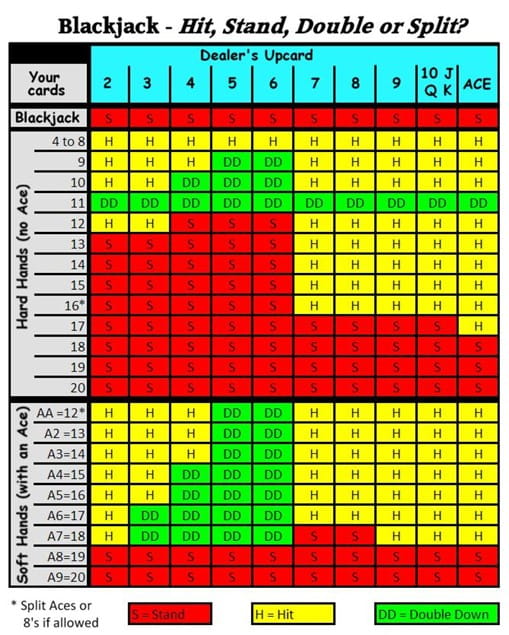
Regularly reviewing this chart, especially when unsure about hitting or standing, can drastically reduce the house edge. That’s why many experienced players keep one handy while playing online.
Mistakes to Avoid When Hitting or Standing in Blackjack
Even seasoned players sometimes fall into these common traps:
- Always hitting on 16 isn’t the best choice; you need to consider the dealer’s upcard, as standing can be better if the dealer is likely to bust.
- Standing on soft 17 isn’t always the smartest move because soft hands give you more flexibility, and hitting often makes more sense.
- Ignoring the dealer’s card is a mistake; your strategy should adapt based on the dealer’s upcard.
- Making decisions based on emotions, such as letting a losing streak affect your next move, usually leads to bigger losses.
Other Advanced Blackjack Strategies
Once you’ve got the basics of hitting and standing down, you can step up your game with advanced strategies. Card counting helps track which cards have been played to better predict what’s coming. Paying attention to how deep the dealer is into the shoe, known as deck penetration, can affect how reliable your counts are.
You should also adjust your play based on table rules, like whether the dealer hits on soft 17 or how many decks are used. Lastly, managing your bankroll wisely by adjusting bets to your current streak and confidence keeps your play balanced and controlled.
Ready to test your new blackjack strategy?
Put your knowledge of when to hit or stand into practice at Highbet. Play now at our online casino and build your confidence at the tables, no matter if you are just starting out or aiming to improve your strategy.